Tuesday, December 20, 2011

Comforts, Quirks, and Company

Hoosier Winter
This Christmas is very much a working holiday. I'm striving to complete my final dissertation chapter by December 31, so I'm not indulging in nearly as many movies, walks, or visits as I normally do when visiting Indiana. However, even while racing toward my deadline, I have been able to appreciate many of the good things about being here, in my first of all homes:

1. Kind Inquiries from Federal Employees: As I stepped onto the porch to retrieve the mail on Tuesday, the postman stopped and shouted, "Well, how is Baby Bear? Get good grades this semester?"
2. Things that Do Not Change: For more years than I can remember, my mother has used the same wrapping paper to wrap my presents. I suppose when you save a certain paper for one person, it can last a long time.
3. Creature Comforts: Writing a dissertation is much more pleasant with a purring cat curled up on my lap (or, less conveniently, in front of my keyboard)
4. Other Things that Do Not Change: My parents' Christmas tree will always be, in my estimation, the best of all trees.  Every ornament has a story. I especially like the angels made from aluminum foil, which Mama made when she and Daddy were first married.
Grocery shopping with Mama
5. Deliciousness: On Wednesday, Mama made eight casserole dishes full of homemade party mix. As far as I am concerned, this is our Christmas feast.
6. Quirks I Did Not Realize Were Quirks until I Left Home: On our living room walls, my parents have maps of Narnia and Middle Earth, but there is not a single family portrait to be found on any wall in the house. 
7. New Delights: Daddy is reading Harry Potter for the first time (he's just started the sixth book), and I love hearing his first-time reactions to the stories.
8. Quotidian Grace: Mama and I spend quality time together by running errands.
9. Sartorial Redemption: The Helping Hands thrift store in West Terre Haute, Indiana yields many treasures.
10. Good Company: Miscellaneous college and international students are in and out of the house at all hours.
11.  Ties that Bind: I spent last night and most of today with Lennon, Amy, and Andrew--kin by so much more than blood. (Amy, by the way, is a fabulous baker and blogs her creations here. If you're in central/southern Indiana, you should hire her to bake you a cake!).


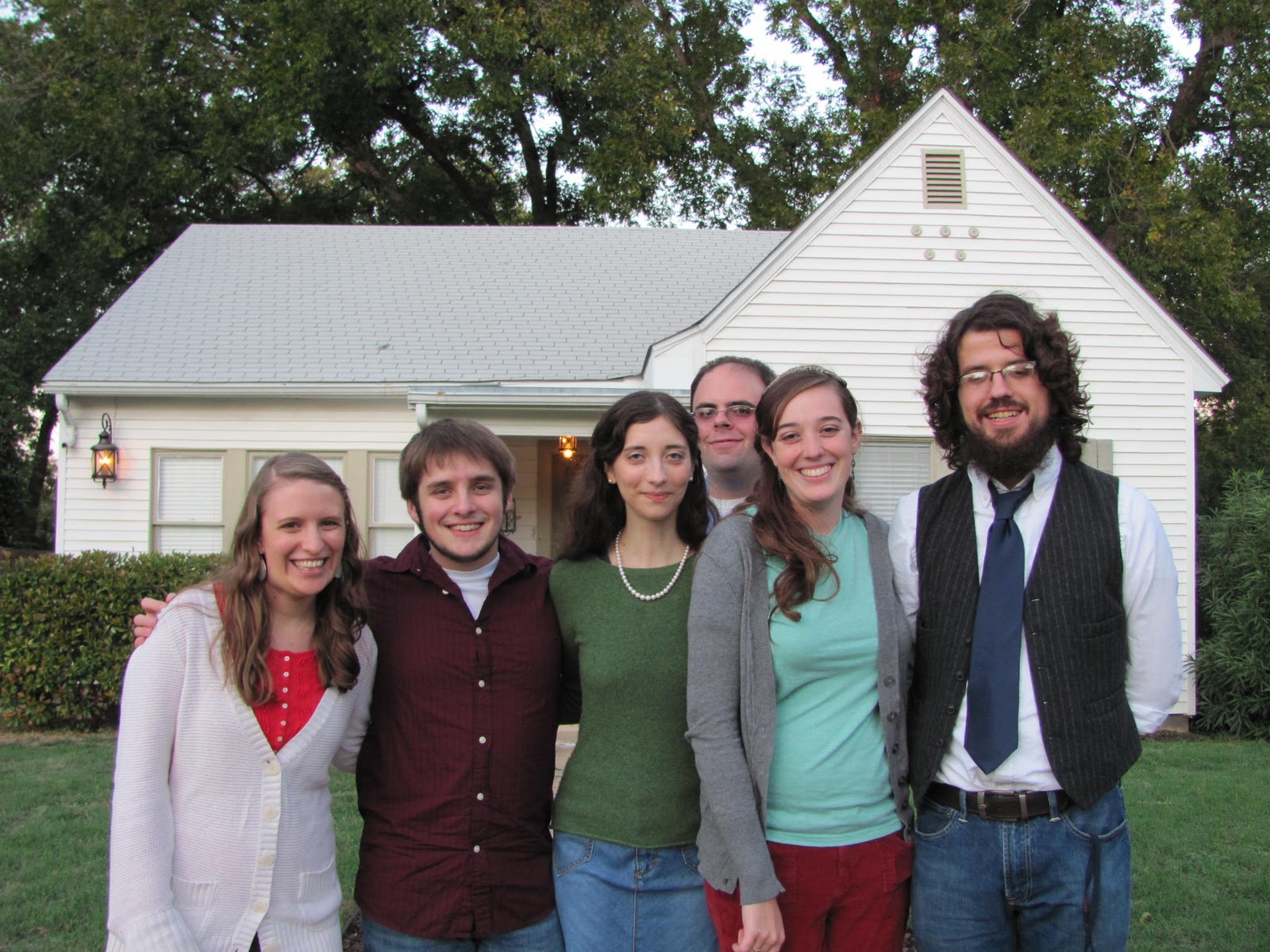
Lennon, Amy, and Andrew with "Aunt Bethany"
A more typical glimpse of our time together.


Where are you this Christmas? What are some of the good things about being there?


Waiting my Way Home

"Ben, you're my last hope," the station agent said into the phone. "You see, I've got this passenger who needs to get to Ft. Worth and--oh. You're in San Antonio? Oh, never mind, then."

After five hours of waiting for a train, this was not what I wanted to hear from the Amtrak station agent. My northbound coach, the Texas Eagle, was schedule to depart from McGregor at 11:50 AM on Sunday, but an accident north of Austin had led to a series of delays. All the passengers who had been on the train were loaded onto buses, and train service was to resume in Ft. Worth. After a series of frustrating conversations with operators, who seemed to know about as much as I did about what was happening, I finally learned that one of the five buses knew I was waiting in McGregor and would be coming to take me to Ft. Worth.

Waiting for another train, July 2007
By 5 o'clock, however, the station agent was beginning to worry that the bus had either forgotten me or was not going to arrive in time to get me to Ft. Worth.  Just before he called Ben, I had overheard him say as much to Maria, the station agent at Temple, Texas. "Do you know where he is?" my agent asked. "No, I can't hail Billings, either." The inability to "hail Billings"--the driver of the bus that was supposed to come for me--had become the last in long series of obstacles to my journey home for Christmas.

I should pause here to note that my wonderful, amazing, patient housemates had been waiting with me all afternoon, and when Jennifer realized that Billings-the-bus-driver was incommunicado, and that Ben-the-taxi-man was in San Antonio, she said, "Could we take her to Ft. Worth?"
"Could you?" the agent replied, relief visible on his face. "That would be best, because we just can't seem to hail Billings....and Amtrak could reimburse you for the gas."
"Okay. We'll do it. When would we need to leave?"
"Well, um, right now."

And so Grant and Jenn, who had originally planned to wait with me for fifteen minutes, drove me two hours to Ft. Worth, arriving about ten minutes before the northbound train pulled out of the station.  The generosity, patience, and love they exhibited was more than I could have asked for, and they, bless them, didn't even make me ask. They simply saw my need and met it without fuss or fear.

At the beginning of Advent, I wrote about how I have found it difficult to be faithful in waiting (read the full reflection here). Writing that entry humbled me because for most of my life I have thought of myself as being fairly good at waiting. In college, I liked to quip, "Delayed gratification is good for the soul," too often dismissing my friend Rachel's protest: "Yes, but it is hard on the heart."

My long day at the train station reminded me that waiting is much easier to bear with friends. This is hardly an original observation, but it is a truth that has come to dwell with me this year. Often, people describe life as a journey, and friends as our companions on the road. It is wonderful to have friends travel alongside me, but in some ways I am more encouraged when I realize that my friends are waiting with me as circumstances, sickness, or uncertainty stand in the way of progress.

And so tonight, safe and warm in my childhood home, I am thankful for Grant and Jenn, who waited with me all day, hugged me when it looked like I might not get home at all, then took action as soon as they saw a way to speed me on my journey.

I am also thankful for all the memories of other friends who have waited with me. I remember the spring I was preparing for my preliminary exams, when Adrienne would  come over and study with me, to help me stay calm and hopeful. Steph stayed up with me all night as I graded a mountain of essays and exams. And then there was that wonderful piece of pie Liz brought to the library during my second year of grad school. I was working frantically to finish a term paper, and she came and sat with me until the wee hours of the morning. In college, I once became sick on a night my friends and I had planned to cook dinner and watch a movie. They put me to bed upstairs, and whenever I would wake, one friend or another--first Rachel, then Keith, Mari, or Mark--would be sitting across the room, waiting quietly in case I might wake and need something.

As a single adult, I do not expect anyone to wait with me for a train to come or for a night to pass. No one is obligated to tend me if I am sick, to drive me to Ft. Worth, or to keep me company if I must work late into the night. Consequently, whenever a friend does wait with me, I know their waiting is a form of grace. When they wait, they say, "We believe this will end -- we believe you will get home, you will finish this essay, you will be well again."  But they also say--and this is such a gracious mystery--"This moment is good, too. "

At Advent, and during all our  seasons of waiting, we need such friends. Their presence reminds us that our savior's name is "Emmanuel"--God with us.


Tuesday, December 13, 2011

Handed Down and Made by Hand

"Why do we give gifts at Christmas?" My friend Dustin asked this question as he led discussion in Sunday School this week. During Advent, our church has been studying the Advent Conspiracy, a campaign that calls Christians to make Christmas celebrations vivid and effective testaments to the Gospel. (Click here for the Conspiracy's most recent promo video). The tenets of the Advent Conspiracy are that we should "Worship Fully, Spend Less, Give More, and Love All" in ways that counter the glut of money, time, and anxiety most Americans spend on Christmas presents.

As our Sunday School class discussed ways to live out these ideals, I spoke about the gifts my parents used to make for me. In response to my recent post about traditions, many of you wrote that making Christmas presents helps you celebrate. As a child, my favorite gifts were things my mother or father made for me. The first Christmas I can remember, I awoke to a toy kitchen my father had built. Often, I would catch hints of these projects during the months leading up to Christmas. From a time before I was old enough to see over the kitchen table, I can remember marveling at the pieces of fabric and yarn that would eventually become Raggedy Ann and Andy dolls. Years later, I would sneak into the basement to peek at the doll's trunk my father was building, or I might catch a glimpse of calico that would somehow become a little dress by Christmas morning.

Making or buying handmade gifts certainly answers some of the Advent Conspiracy's calls. By making gifts for me, my parents spent far less money than most American parents, yet they gave me gifts I will always treasure for the time, care, and thoughtfulness they required.

Homemade, matching nightgowns, so Bethany can be just like Mama, 1987.
However, these happy reflections didn't quite answer Dustin's question. Can making gifts teach me about worship?  Can any kind of Christmas gift-giving help us experience and proclaim the Incarnation?

 Before I had an answer to these more difficult questions,  Jeremy spoke up from across the room. "I think giving gifts can teach us about the Incarnation," he said. "Ideally, any Christmas gift should remind us that Christ's willingness to live among us was a gift. But think about Bethany's story -- she saw signs of the gift long before it came. From the hints and signs in her house, she learned that good was coming, and that one day those bits and pieces would become something wonderful because her parents loved her. Maybe that's one way giving gifts can teach us about Christmas -- by reminding us that something more is coming from one who loves us."

The more I think about Dustin's question, the more I like Jeremy's answer.  Making a gift for someone requires the kind of love that God has for us: I should know the colors that catch her eye, the shape that will suit him best. I should notice that she shivers on our evening walks, or that he always plays that certain song after long days. Once I have found a need or desire I have the power to fulfill, I look for the finest materials and select the most skillful pattern. Then I work in secret, anxious to fill my friend with joy, but waiting for the proper season. Once finished and given, these gifts are one small way I can send some of myself with my friends--all so scattered and far. The gifts I make are signs of my hope that busy schedules and long miles will one day pass away, and we can enjoy all our work and rest side by side. Unlike God, I don't have the power the make that hope reality. However, the love that grounds the desire is divine.

Jackie learned the pattern as a girl in France.
This Christmas, I have scores of ideas for gifts that can help us recognize aspects of God's creative, generous image within us. However, some of my readers will soon be recipients of these gifts, and so I will save most of those ideas for the new year. Instead, I will share one project idea that is going to someone I am sure does not read this blog.

This gift is a pair of knitted slippers. I love knitting, in large part because it leaves the mind open for conversation or prayer. I transcribed the pattern from Jackie, my surrogate "grandma." Jackie came to America from France in the 1940s, and each Christmas I look forward to receiving a cup of tea and an hour of stories from her. I am excited to share this pattern with you because it could be the emblem for these ruminations of handmade gifts. Jackie once gave me a pair of these slippers, and I wrote the pattern down at her kitchen table last December. My notes, a strange composite of English and French, provide a very rough prophecy for the warmth the actual slippers will provide, and I love the idea that I am passing the pattern to you as it was passed down to me.

You can find the pattern by clicking here for Grandma Jackie's Slippers.

I think it has a rather pleasingly elfin look to it.
 I still have many gifts to finish before Christmas, and sometimes I think how much faster it would be to buy a gift I could put in my friend's hand today. For mere mortals, waiting can be difficult for the giver as much as for the receiver. I hope I am learning that in the patience and waiting it requires, making gifts offers yet another lesson in experiencing the slow hope of Advent.


What is the most meaningful handmade gift you have ever received or have given? Do you think giving gifts at Christmas can teach us anything about the Incarnation?


Sunday, December 11, 2011

Christmas Giveaway Winner!

Many, many thanks to all who shared Christmas traditions in response to my most recent giveaway. All your traditions inspired me, and the winner of the random drawing is.....


Christmas is a time for good books. Mama and me, 1989 or 1990.


Rachel, who wrote about keeping an Advent calendar and reading Scripture with her family. Congratulations, Rachel! I hope you find some wonderful new traditions to establish in A Foxfire Christmas.


Saturday, December 3, 2011

Christmas Giveaway!

I have been far more cheerful since writing my last entry on Advent as a season of waiting, thanks in large part to all the kind words I received from my friends and readers. Cozy sentiment can obscure the fundamental strangeness of Advent and Incarnation, and the fact that circumstances are challenging the "mood" I expect from Christmas is medicinal. Waiting in hope should be one of the ways Christians bear witness to the Gospel, and I am determined to be defiant once again: I will be merry, I will shout "tidings of comfort and joy" even if  I don't always feel that comfort myself.

Today's entry is a very little (but very happy) way of indulging that defiance. To one reader, I will give away a copy of A Foxfire Christmas: Appalachian Memories and Traditions. This little book is dear to me for several reasons. First, although a Texan and a Midwesterner by birth and upbringing, yearly trips to North Carolina instilled in me an early love of Appalachia. Attending college in East Tennessee deepened this love, and when I am weary or tired, the retreat I imagine is usually a cabin hidden somewhere in the Smoky Mountains.

The Foxfire series began as an effort to preserve the folkways of Appalachia, and to bring students into contact with the resources and stories of the past. According to the series website
"Foxfire" is the name that an English class picked, in 1966, for a student-produced magazine they chose to create, containing stories and interviews gathered from elders in their rural Southern Appalachian community. [...]


 "Foxfire" is the name of a series of books which are anthology collections of material from The Foxfire Magazine. The students' portrayal of the previously-dismissed culture of Southern Appalachia as a proud, self-sufficient people with simple beliefs, pure joy in living, and rock-solid faith shattered most of the world-at-large's misconceptions about these "hillbillies.

I have two Foxfire books, and they delight me. Not only do I love "hearing" the voices of the men and women interviewed for the project, I take a comfort in knowing that in the event of some apocalyptic, survivalist kind of emergency, I have a book on my shelf with instructions for building a spinning wheel and butchering a hog. A Foxfire Christmas selects the best Christmas stories, recipes, and ideas from the Foxfire series and compiles them into a little compendium of traditions and tales. In it you can find plans for a pine-wood race car and cloth doll; recipes for gingerbread, dumplings, and popcorn balls;  and recollections about traditions of Christmas past. Because so many Appalachian families celebrated Christmas in spite of extreme poverty, many of these traditions provide simple and beautiful alternatives to big Christmas productions and high-cost gifts.

Home is a place we create and sustain traditions, and Christmas is one of the best times for renewing our holy-day (holiday) habits. If you would like to be entered to win a copy of A Foxfire Christmas, leave a comment below that answers this question: What are some Christmas traditions that help you experience the joy of Christmas? Are there any new traditions you would like to start with your friends and family this year?

Be sure to leave an email address so I can contact you if you are the winner. Contest ends on Wednesday, December 7 at 11 PM.

Wednesday, November 30, 2011

A Season of Waiting

I have been dreading Christmas this year.  My eight-year-old self would be horrified at such blasphemy; my twenty-eight-year-old self is certainly not pleased to admit how grimly I have watched December's approach.  Ever since I can remember, I have exulted in the approach of the Christmas season. Beginning in kindergarten, I began recording Christmas "radio" shows, complete with carols, special guests, and thrilling dramas about motorcycle gangs (yes: motorcycle gangs. Don't ask me why.).

Living on an academic calendar my entire life only enhanced the inherent joys of Christmas. Before I started school, Christmas marked the season when my parents' lives calmed down for several weeks, and once I entered school, the holiday break provided long and blissful days for listening to Orson Wells narrate A Christmas Carol or hosting Christmas tea parties.

Even grad school, so often an enemy to comfort and joy, has never before jeopardized Christmas. I have endured many sleepless nights finishing seminar papers or grading exams, but by the time Christmas itself comes, I have always been able to leave my work alone for a week or two, at least. Christmas has represented a clean break between semesters.

Why, then, has this year's holiday filled with me such reluctance, even dread? Because for once, I cannot pretend that Christmas is my reward for a semester of superhuman activity. Certainly, I have been working hard--painfully hard, unceasingly hard--on teaching, my dissertation, and job applications. My dissertation is coming along well, but job applications have unsettled me far more than I expected.  Whenever anyone asks me how the process is going, I hear a sanguine voice say something about "exciting prospects" and "trusting God," but somehow I don't sound so chipper when talking to myself. I have sent out more than twenty applications, and now I must wait. Many preliminary interviews for academic positions occur at national Modern Language Association (MLA) Convention at the beginning of January, and not knowing whether or not I will have an interview has been overshadowing my eagerness for Christmas.

Waiting for news about interviews reminds me how many other things I am tired of waiting for: I am tired of waiting for a job that does not require every waking moment, for some sense of where I will be at this time next year, for reconciliation with a friend. 
Always waiting
 Only this week have I recognized the root of my discontent: I refuse to welcome Christmas--the feast of the Incarnation--because I am sick of waiting.  I do not want Christmas to come because I am not ready: I have not worked hard enough, it seems, to earn a fruitful and peaceful Christmas vacation.

Despite my reluctance, I began my traditional holiday reading on Sunday--selections from Watch for the Light: Readings for Advent and Christmas. The voices the editors of this book gather--from Bonhoeffer, Donne, Hopkins, L'Engle, Romero, and many more--have been my guides toward Christmas for years. Last night, the reading was from Henri Nouwen, and his words made me ashamed of my selfish impatience. After observing that waiting is a very unpopular attitude in our culture, Nouwen writes
...waiting is even more difficult because we are so fearful. One of the most pervasive emotions in the atmosphere around us is fear. [...] Fearful people have a hard time waiting, because when we are afraid we want to get away from where we are. [...] It impresses me, therefore, that all the figures who appear on the first pages of Luke's Gospel are wiating. Zechariah and Elizabeth are waiting. Mary is waiting. Simeon and Anna, who were there at the temple when Jesus was brought in, are waiting. The whole opening scene of the good news is filled with waiting people. And right at the beginning all those people in some way or another hear the words, "Do not be afraid. I have something good to say to you." These words set the tone and the context. Now Zechariah and Elizabeth, Mary, Simeon and Anna are waiting for something new and good to happen to them. (27-29)

This time before Christmas, Advent, calls God's people to wait. Simeon and Anna did not look forward to the coming of the Messiah as something they could accomplish, but as something they waited for God to do. Their role was to wait faithfully and watch carefully, doing the work before them.

I am faithless if I let my own impatience and anxiety deprive me of the joy that comes with Christmas. So I am waiting. So my future is uncertain. So I may not have done "enough." The Word of the Lord has come to dwell among us, and that Word says, "Do not be afraid. Good is coming." Maybe in my life that good will take the form of news about a job interview. Maybe not. Regardless, Nouwen and other messengers-of-the-most-High challenge me to wait in hope, and when Christmas comes, I will remember that this hope is about much, much more than my job prospects or a vacation from school. Freedom from selfishness, salvation from fear, the redemption of all creation--these are hopes much better than anything the MLA could offer.


Saturday, November 26, 2011

The Young Adult's Guide to an Awesome Thanksgiving
(compiled from four years of wonderful Waco celebrations)

My nook, Thanksgiving 2006
1. Stay where you are. If home is a place we go for holidays, be intentional about celebrating in the place where you live, work, or study.  Celebrations are one way to consecrate a place as home.

2. Be extravagant with your cooking. Buy the best and finest food, and prepare it with care and courage.

3. Invite anyone you can think of who might be alone or lonely. 
Thanksgiving 2011 Photo by Kt


4. Let the kitchen fill up with food and people and merry chaos.
Thanksgiving 2009

5. Serve sweet tea and tamales along with the turkey and dressing.

4. Try to celebrate with an equal number of family members and friends. Introduce your teenage cousins to your grad-school colleagues.  Recognize that the highest bonds of kinship are far above blood, nationality, or common interest.

5. Sing your prayer before eating. "For the Beauty of the Earth" makes a perfect Thanksgiving blessing. Don't be afraid to demand all four verses. 

Thanksgiving 2011 Photo by Kt
6. Go for a long walk after feasting and lingering at the table. Point out beautiful doors and interesting trees in the neighborhood. Say, "Happy Thanksgiving!" to everyone you see.

7. Try all the pies.

 Photo by Stephanie Harris Trevor
8. Give thanks for all the Thanksgivings past. Remember what it was like to sit at the kids' table. Try to name the songs Casey played when he came up from Ft. Hood for Thanksgiving in 2008.  Let Grant and Jenn know how much you appreciated being rescued from a solitary Thanksgiving last year. Laugh at the way Jon never let your wine glass go empty during that first holiday with friends.

Room for more, 2011. Photo by Kt
9. Let yourself be sad for all the miles, years, or hard conversations separating your from people you love. Cry a little if you must, but then imagine that your table is growing longer and longer, and that by the time dessert is served, every seat will be filled with some faraway friend.

10. Write letters to people you are thankful for. Name specific reasons you give thanks to God for them.

Thanksgiving 2008


11. Rest. Don't be ashamed to drift off to sleep as the room fills with low conversations or the buzz of a football game.

12. Don't fret about how or where or with whom you will celebrate next year.  Give thanks for the hope that God will bring you to some glad table, whether as host, guest, daughter, or friend.


Thanksgiving 2008

Thanksgiving 2008 My strangely pinched smile does not do justice to my very real joy at this meal.

Another Thanksgiving, another weird smile. The grad students, Thanksgiving 2011.
Thanksgiving 2011. All is well.


How did you celebrate Thanksgiving this year?