Monday, January 10, 2011

Making it Home: How Does Your Garden Grow?

It runs counter to my Midwestern intuitions to reflect on gardening during the “dead” of winter, but I live in Texas now, and last week's enormous harvest of collard greens reminded me that I have been planning a post on gardens for several months.  
In 2010, I learned that home is a place we plant gardens. Although the daughter of a man who revels in dirt and seed and harvest,  I had done little more than tend houseplants (and poorly, at that) until last year.  My church began a Community Garden in February, and later in the spring, some friends and I began our own plot in a spare corner of our apartment complex’s property. 
These earth-experiments attracted me for several reasons: I thought participating in a garden would support my efforts to eat only in-season produce; I needed a  reason to spend more time outside; and I looked forward to working with others on a shared project.  A less conscious but more powerful reason, however, is that I cannot remember a time when my childhood home did not have a flourishing garden in the summer. Ironically, for most of my childhood I disliked tomatoes, squash, and many other good things that grew in the garden, but my pickiness did not undermine my association of “home” with a place where things grew and were eaten, where summer nights were spent seeking ripe tomatoes, and where my father would often walk a wheelbarrow full of vegetables to our church so friends could take as much as they pleased.
Those Indiana gardens manifested some of the best things about my father--his love of growing things (both botanical and human), his delight in nature, his generosity--and as I reflect on my novice dirt-dabbling, I find that many of my experiences finding a home in Waco have parallels in the garden. 
With my father in the garden, circa 1987
Both gardens have reminded me how thankful I am that my home is also the home of others--definitely-kindred, remarkably-unlike-me others.  The day we broke ground for the community garden, I enjoyed a perfect balance of solitude and community, sometimes concentrating all my energy on clots of wet soil I was breaking up, and at other times discussing everything from theology to television with the person working next to me. The apartment garden was a joint project between me and two couples--Jon and Steph, Taylor and Rachel.  Working with Jon and Taylor on the garden was a study in personality differences--had I been making the garden on my own, I would have planned for months, fretted over asking permission to use our complex’s property, and probably never would have planted anything at all. Taylor and Jon, however, wasted no time, and they were tilling the soil long before I had finished debating whether it would be better to call or write our apartment manager for permission.  We planted our first rows on an unusually cool day in May, and as I made mounds for squash and Jon prepared rows for corn, with Taylor hacking away at the tall grasses that obstructed an inlet of the river, I was both proud and thankful to have such friends. 
The gardens have also reminded me that being really at home in a place involves constant care--housekeeping, if I may use the word broadly. Until we realized there was a hose and spigot within reach of the garden, we watered our plants with buckets of water drawn from the Brazos river.  The river is about thirty or forty yards from our plot, and it usually took me three buckets-full to water everything. I would lean out from a concrete pier, toss my bright pink bucket four to six feet down into the water, and then haul it up with a rope. It seemed to be an absurd amount of work for a few rows of parched vegetables, but as I labored with those heavy, sloshing buckets, I realized that I was experiencing something very ordinary for most women throughout history--the difficult and even dangerous work of collecting the water needed to sustain a home and family. My great-grandmother, a teenage bride on the Mississippi delta, had to walk for miles to gather water from a reliable well, and all over the world today, many girls and women spend hours of their days carrying water.  Although even I am not Luddite enough to prefer buckets to hoses, I appreciate learning from my sore muscles and unsteady bones that home, like any other garden, must be tended consistently and carefully. Furthermore, in order to tend it, one must often defy distance, impatience, and even gravity.
These gardens have also taught me that the harvest is not always what we expect, any more than the homes we build as adults will resemble the pictures we carried or created from childhood. For most of the summer and fall, our apartment garden disappointed dreams of lavish salads and salsas: we gathered pitiful tomatoes, scanty bell peppers, and a pittance of purple-hull peas. The only thing we had in abundance was okra, the titan of our little world, overshadowing everything else. Far more satisfying was the harvest of neighbors our project brought.  We live in a quiet apartment complex, and, as in many such places, the residents do not go out of their way to meet one another. However, the garden provided a wonderful way to meet our neighbors. Sheila, a grandmother who lives on the first floor, joined with us and contributed several squash plants. Several times while weeding, I was hailed by Sophilia, a law student reading on her balcony.  She had noticed the plot and knew Taylor and Rachel, and when I explained what we were doing, she exclaimed, “Oh my gosh! You guys are such hippies!” For the rest of the fall, I would look forward to talking with Sophilia and her roommate on my way to the garden. Daniel, who was using the hose to wash his kayak when we first met, now brings the hose down to me when I am among the peppers and greens, making suggestions for our spring planting. Les and Katie, who have four children and coach youth baseball, ask how the peas are doing when we meet at the mailbox. From these small but precious encounters, I am reminded that people are more at home with one another when they have some common thing--whether a tiny garden or a book or an ideal--to consider, to protect, or to love. 
And now I am enjoying a winter harvest--something I never experienced from my father’s northern garden. In spite of the dislocation and uncertainty that have shadowed my efforts to build a home in Texas and in my twenties, suddenly I am faced with a marvel: in a season I once thought dead, food flourishes in the dirt.  I never thought collard greens could be so profound.
Thus says the Lord of hosts, the God of Israel, to all the exiles whom I have sent into exile from Jerusalem to Babylon: Build houses and live in them; plant gardens and eat their produce. (Jeremiah 29.4-5 ESV)
Do you keep a garden? What do you grow? 

P.S. In honor of these gardens (and of National Soup Month), I am sharing the recipe I invented to use the greens I now have in abundance.  This was a use-what-I-have-on-hand experiment, so feel free to adjust according to your pantries. If you don’t have wheat berries, you might try using barley or pinto beans. 
Collard and Potato Soup
1 T olive oil
5 cloves minced garlic
6 cups vegetable stock 
5 small potatoes, peeled and sliced
1 cup wheat berries 
6-8 large collard and/or chard leaves, coarsely chopped (about 2-3 cups)
1/2 - 1 T Worcestershire sauce (adjust to taste)
1/8 t cayenne pepper
1-2 t sea salt or kosher  
fresh ground pepper

Heat the olive oil in a large (4-5 qt) saucepan or dutch oven. Add garlic and saute until golden. Add broth and bring to a boil.  Add potatoes and wheat berries. Reduce heat and simmer until wheat berries are tender (about 45 minutes). Add Worcestershire, cayenne, and salt. Adjust seasonings to taste. Add greens, cook until wilted (about 10 minutes). Garnish with pepper. 

Sunday, January 9, 2011

Christmas Storytime: The Snow Queen, Conclusion

I fully intended to conclude my reading of "The Snow Queen" within the Twelve Days of Christmas, but I was happily busy with contemplation, family, and travel until Epiphany.  However, since neither my conscience nor my aesthetic has much patience for unfinished stories, I am now posting the remaining installments of "The Snow Queen." These were recorded back in Texas, in my kitchen on a cold and rainy January night.  I hope you enjoy these. I'm especially fond of Part 5, which features a little robber girl who is both murderous and kind-hearted.
The Fourth Story, In Which Appear a Prince and a Princess


The Fifth Story, Which Is About The Robber Girl


The Sixth Story: The Lapp Woman and the Finnish Woman

The Seventh Story: What Happened In The Snow Queen's Palace and Afterward


What do you think of the conclusion of the story? What do you make of Kai's "game of reason" and Gerda's power to rescue him?

Sunday, December 26, 2010

Christmas Storytime: The Snow Queen, Part 3

Happy second day of Christmas, everyone! Tonight, I give you Part 3 of "The Snow Queen." Once again, I didn't practice this reading before I recorded it, so please forgive the lapses, especially regarding the tone of the snowdrops' story.
What do you think of the story so far? What do you think has happened to Kay?

Wednesday, December 22, 2010

Christmas Storytime: The Snow Queen, Parts 1 and 2


It has been a few years since I read many of Hans Christian Andersen’s tales, but I enjoyed “The Little Match Girl” so much that I thought I would share another Andersen story tonight.  “The Snow Queen” is a rather long fairy tale, consisting of seven smaller stories, so this reading includes the first and second stories. Please forgive my pigtails and pajamas; Mama and I were cleaning out the basement all day, and after un-grubbifying myself, it didn’t seem worthwhile to put on normal clothes just for friends and fairy tales. 


Monday, December 20, 2010

Christmas Storytime 3.1: "The Little Match Girl"

For my entire life, home has been a place where stories are read, invented, and shared.  When I was a child, my parents read or told stories to me nearly every night. In college, as I began to write my honors thesis on literary fairy tales, my friends said, “Well, if you’re going to be reading fairy tales all year, you should read them to us.” I agreed, and for most of my senior year, an assortment of friends would gather in my room, and I would read to them from Grimms’ Fairy Tales, Hans Christian Andersen’s stories, The Chronicles of Narnia, and much more.  In graduate school, my academic and professional study of stories proceeded with greater rigor than ever, but I missed having people to sit in a room with me and share stories.  During my Christmas vacation two years ago, I recorded a few of my favorite Christmas stories for friends who were far away. I continued these recordings last year, and this year I am very happy to introduce Christmas Storytime Volume 3 on my blog this year.  The reading is unpracticed, and I can boast of no video editing skills, but I hope the “homespun” quality of this video makes you feel  as though you have joined me in my parents’ living room for a story before bedtime. Tonight’s story is “The Little Match Girl” by Hans Christian Andersen. Enjoy, and watch for more installments in the coming weeks.


Saturday, December 18, 2010

Making it Home: Christmas Letters

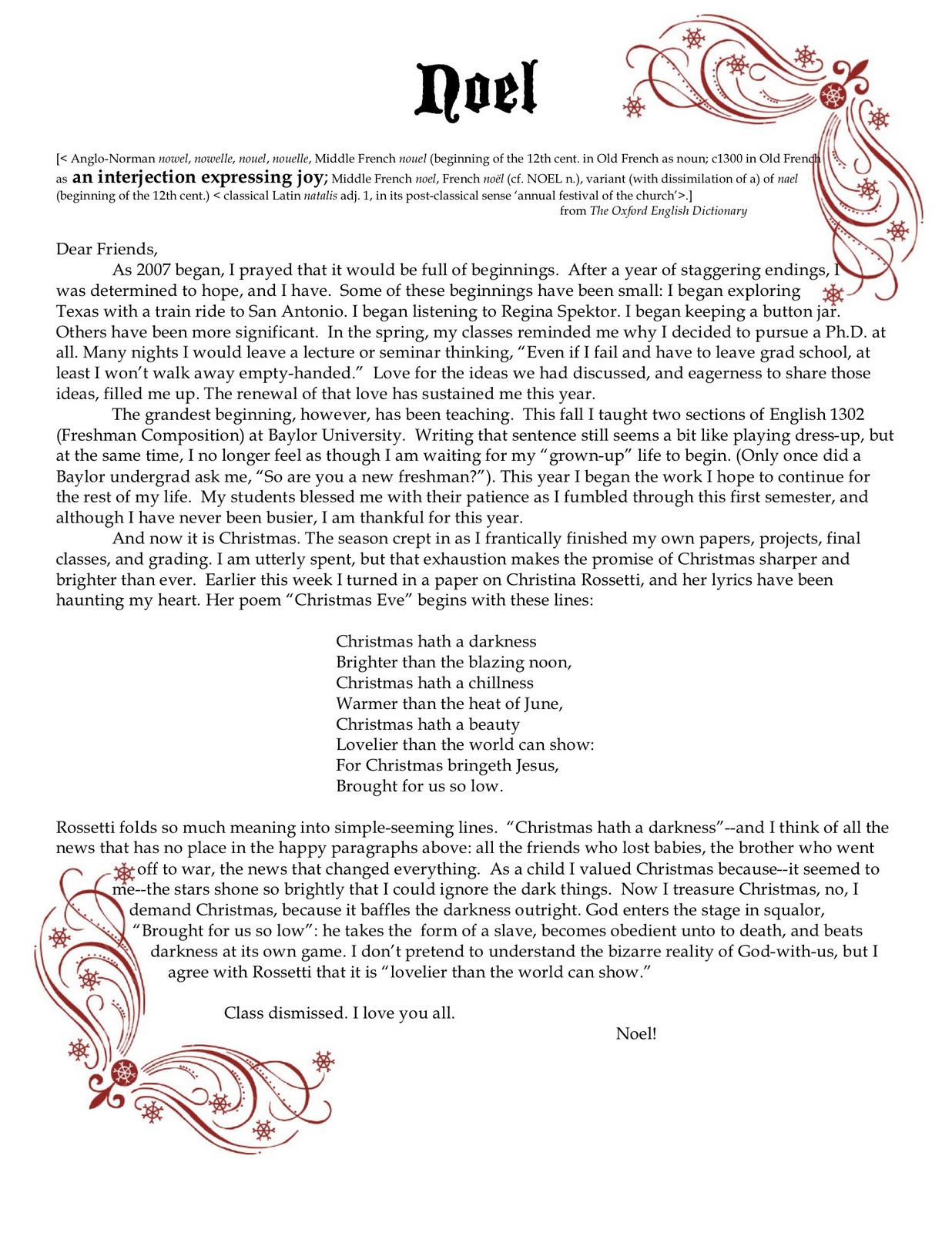
Between submitting final grades, working on my prospectus, and hurrying through a mess of other end-of-semester-and-I-am-leaving-town errands, I managed to sustain one of my favorite Christmas traditions: sending Christmas cards.  My powers of verbal formulation are dwindling fast (it is nearly 5 AM and still have things to do before boarding my train home for Christmas in a few hours), but both as a follow up to my recent post on letter-writing and as an introduction to an upcoming series of Christmas posts, I wanted to share a few of my past Christmas letters. You can click the images to make them large enough to read. I hope you enjoy. 
Christmas 2006


Christmas 2007


Christmas 2009
(I’m not sure what happened to 2008. Maybe I’ll find the file when I’m not so sleepy). I'll post this year's letter in a few weeks, once I'm sure all the snail-mail recipients have received their copies. Be of good cheer during this last week of Advent. Christmas is coming!

Do you send Christmas cards and/or a Christmas letter? What do you include in your Christmas letters? What kinds of Christmas letters do you most enjoy reading? 

Tuesday, December 14, 2010

Life Undivided: Home Is Where The Cat Poop Is

For Christmas this year, I am very tempted to give my mother a needlework sampler proclaiming,  in sweetly-stitched letters, “Home Is Where the Cat Poop Is.”  More than a nod to my generation’s fascination with wryly ironic kitsch, this idea is really my mother’s fault. Shortly after beginning this blog, I asked  for a list of things that characterize “home” for her. She said, “Home is the place where, if the cat poops, I have to clean it up.” To be fair, she also offered a number of more cheerful things, but this comment caught my attention, especially since her phone calls have begun to include frequent accounts of feline incontinence.  Our elderly cat, Amelia, has been in our family since I was in the fourth grade, making her a venerable seventeen.  She can still kill mice, chase yarn, bolt across the house, and purr well enough to put any spry kitten to shame, but she has begun to lose her litterbox training. 
When I visited my parents this summer, a considerable amount of my intellectual and emotional energy went toward finding creative solutions to Amelia’s inability (or crochety unwillingness) to use her litterbox. If you are thinking that this is too much information, then you are sharing my own initial response to the cat-poop situation.  When I came back to Indiana, I had just finished a series of harrowing PhD preliminary exams, and I longed for a deep summer’s rest in my childhood home.  I had no interest in playing chambermaid to a cat.
I was quickly reminded, however, that “home” is not the same thing as “escape.”  In fact, ever since finishing high school, homecomings have been complicated. During college, returning to my parents’ home was difficult because I was beginning to build a life for myself elsewhere, and my parents and I had to negotiate the changes my increasing independence entailed.  Coming home as an adult out of college has been unsettling for other reasons.  The cat poop is emblematic of one of the difficult realities of learning what it means to be “at home” with other people: it means surrendering to the needs of others, and recognizing that I have a responsibility to the well-being of the entire household.  As a child, my parents judiciously chose to tell me some things and to refrain from telling me other things. They protected (or tried to protect) me from their worries about finances, jobs, and other grown-up concerns.  Though I had some chores (none of which, I am sorry to say, I performed with much enthusiasm), for the most part I understood home as a place where I could play, study, and rest in peace. As an adult, my role in a home is very different. While I still savor the comforts of the house I grew up, I can no longer avoid hearing about difficult questions or unpleasant jobs. Nor do I wish to.  Much as I hate cleaning up cat poop, I know that when I do, I am at home in that house in ways I could never be if it were only a place to bask and be comforted.  
 It is easy to become sentimental about the idea of home, especially when we feel ourselves displaced from any kind of haven,  but once we are at really at home--whether that means settled in the city where you live, or rooted in a friendship or a church--we begin to realize that there is work to be done--maybe unpleasant, difficult work--and we are the ones who must do it. 
Only love challenges the sentimentality and the disgust that might prevent us from accepting the duties that come with having a home. Love compels us to remain faithful when a friend seems to have given up on a friendship. Love keeps us at the table when the one next to us is grieving, his pain making us wretched and shy. Love binds us to a local church even when it has failed us. Love puts us on committees, keeps us up awake all night tending those who are sick, and helps us give up our time cheerfully.  Love helps me laugh as I help my mother scrub the living room rug. 
Home is where the cat poop is.  Maybe what this means is that home is the place I must pray for an increase of love: love so strong and certain that I no longer hesitate to do the difficult work to make my house clean, secure, beautiful, and welcoming. 
Love teaches me that home does not exist for my sake only. If our apartments, our friendships, our marriages, and our churches exist as outposts of God’s kingdom, they must exist for the sake of that kingdom: in other words, for the sake of delighting in the One who establishes all homes, for the sake of showing love to one another, and for the sake of drawing in those who haven’t yet found their way back.   
 What are some of the hard things you have to do when you are at home in a place, relationship, or church?